
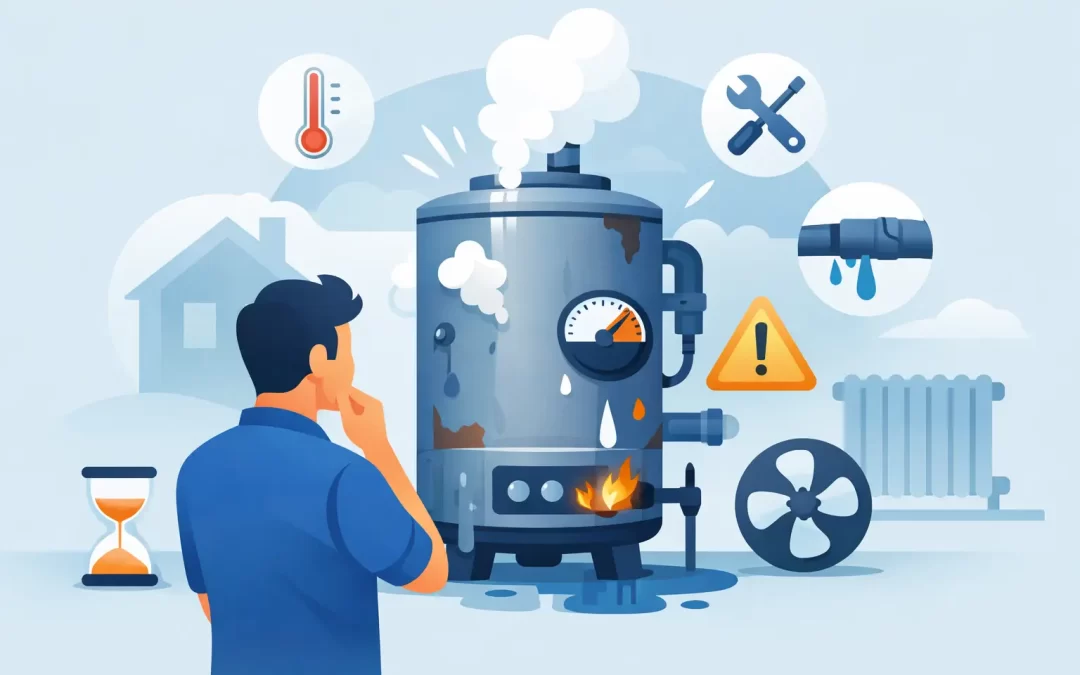
That moment when the boiler cuts out on a cold morning usually comes after months of warning signs. If you are wondering about the best signs boiler needs replacing, the answer is rarely just one dramatic failure. More often, it is a pattern of poor performance, rising costs and growing reliability issues that tells you your boiler is coming to the end of its useful life.
For homeowners and landlords, the key is spotting those signs early enough to avoid a full breakdown. Replacing a boiler is a significant decision, but so is sinking money into repairs that only buy you a little more time. Here are the clearest signs to watch for, and when replacement is usually the smarter option.
The best signs boiler needs replacing
1. Your boiler is 10 to 15 years old or more
Age on its own does not always mean immediate replacement, but it does matter. Many boilers can run for well over a decade if they have been properly serviced and looked after. Even so, once a boiler gets into the 10 to 15 year range, parts can become harder to source, efficiency tends to fall behind modern standards, and breakdowns become more common.
An older boiler may still heat your home, but it may be doing so less efficiently and less reliably than you realise. If it is also showing other faults, age becomes a much stronger reason to replace rather than repair.
2. Repairs are becoming regular
One repair every few years is one thing. Calling out an engineer several times in a single heating season is something else entirely. If your boiler keeps losing pressure, locking out, leaking, or failing to fire up properly, there comes a point where repeated repairs stop being good value.
This is one of the best signs boiler needs replacing because the costs rarely stay limited to the repair itself. There is also the inconvenience, time off work, lack of heating or hot water, and the worry that the next fault will happen at the worst possible moment.
It depends slightly on the age and make of the appliance. A newer boiler with a single isolated fault is often worth repairing. An older one with a growing list of issues usually is not.
3. Your energy bills keep climbing
If your gas usage seems high despite no major change in how you heat the property, an ageing or inefficient boiler may be part of the problem. Older boilers have to work harder to deliver the same result, and that inefficiency shows up in your bills.
This is especially noticeable in homes with old non-condensing models or boilers that have not been operating properly for some time. A modern A-rated boiler can be far more efficient, which means replacement can be about reducing ongoing running costs as much as improving reliability.
Of course, bills can rise for plenty of reasons, including insulation, thermostat settings and energy prices. But if your boiler is old and your heating costs feel steadily harder to manage, it is worth having the system assessed.
4. It struggles to heat your home properly
A boiler does not need to stop working altogether to be failing. Sometimes the signs are more subtle. Radiators take longer to warm up, rooms never feel quite comfortable, or hot water temperatures fluctuate from one day to the next.
Poor heat output can sometimes be caused by other issues such as sludge in the system, faulty controls or circulation problems. That is why a proper diagnosis matters. In some cases, a powerflush or targeted repair can restore performance. In others, the boiler simply no longer has the efficiency or reliability needed to heat the property well.
If your heating has become inconsistent and the system has already been maintained properly, replacement may be the more dependable fix.
5. Strange noises are becoming normal
Boilers should not sound like they are arguing with themselves. Banging, whistling, kettling, gurgling or vibrating noises can point to a range of issues, from limescale build-up and trapped air to pump problems or internal wear.
Not every noise means the boiler must be replaced. Some can be resolved with repair work or system cleaning. The bigger concern is when unusual noises are frequent, worsening, or appearing alongside other symptoms such as poor heating and repeated faults.
A noisy boiler is often a sign that the appliance is under strain. The longer that goes on, the more likely it is that a repair becomes a temporary measure rather than a lasting solution.
When repair stops making sense
6. Replacement parts are hard to find
This is a practical issue many property owners do not think about until a fault occurs. As boilers get older, manufacturers may stop producing certain components. Even if parts are still available, they can be expensive or involve long waits.
That creates a frustrating situation where a boiler might technically be repairable, but only at a cost and timescale that makes little sense. If sourcing parts has become a recurring problem, it is usually a sign the appliance is no longer a good long-term option.
7. You have a visible leak or corrosion
Water around the boiler should never be ignored. In some cases, a leak may come from a valve, seal or connection that can be repaired. In other cases, corrosion in the heat exchanger or key internal components can make replacement the safer route.
Rust, staining and persistent moisture are red flags, particularly on older units. Left unresolved, leaks can damage surrounding areas and create wider system problems. If the boiler casing or internal parts are showing age-related deterioration, repair may only delay the inevitable.
8. The pilot light keeps going out or the flame looks wrong
On older boilers, issues with the pilot light can indicate wear or faulty components. A flame that looks weak or yellow rather than blue can also point to combustion problems. That is not something to leave and see what happens with.
Any concern involving combustion or gas safety needs professional attention straight away. Sometimes the issue can be repaired, but if the boiler is older and already unreliable, replacement is often the wiser decision for safety and peace of mind.
9. Your boiler no longer suits the property
Sometimes the boiler itself is not failing badly, but it is no longer right for the home. This happens often after extensions, loft conversions, bathroom upgrades or changes in household size. A boiler that once coped fine may now struggle with demand.
If you are constantly running out of hot water, waiting for the heating to catch up, or dealing with uneven temperatures, the issue may be capacity rather than a simple fault. In that case, replacing the boiler with the right type and output can make a big difference to comfort and efficiency.
This is especially relevant for landlords improving rental properties or homeowners modernising older houses across London and the South East.
10. You are losing confidence in it
This may sound less technical, but it matters. If you spend winter wondering whether the boiler will start each morning, or if you hesitate to leave the house because the heating has been unreliable, that lack of confidence has a real cost.
Heating and hot water are not luxuries. For most households, they are essentials. Once a boiler becomes a source of stress rather than reassurance, replacement is often the right decision even before complete failure.
Should you repair or replace your boiler?
There is no single rule that fits every boiler. A newer appliance with one faulty part is usually worth repairing. An older boiler with repeated issues, poor efficiency and rising running costs often is not.
A useful way to think about it is this: if a repair restores confidence and gives you a reasonable period of reliable service, it may be worthwhile. If it only patches over the latest problem while the next one is already on the horizon, replacement is usually the better investment.
A proper assessment should look at more than the fault code on the day. It should consider the boiler’s age, condition, service history, parts availability, efficiency and how well it matches your property’s needs.
Why acting early can save money and stress
Waiting until the boiler fails completely can seem sensible if it is still limping along, but emergency replacement is rarely the easiest route. You have less time to compare options, less flexibility around installation dates, and more pressure if the property has no heating or hot water.
Planning ahead gives you more control. You can choose the right boiler for the home, prepare for the work properly and avoid that mid-winter panic when the system finally gives up.
For many households, finance options can also make a planned replacement more manageable than a rushed emergency decision. That can turn a major household expense into something more predictable.
If your boiler is showing several of the signs above, it is worth getting honest advice before it breaks down altogether. A trustworthy engineer will tell you when a repair is sensible and when replacement is the safer, more cost-effective route. Companies such as CKT Boilers focus on exactly that kind of practical guidance – keeping homes safe, warm and properly looked after without making the decision more complicated than it needs to be.
If your boiler has started to feel like a gamble, that is usually your clearest sign to stop waiting for the next fault and start planning for a better, more reliable system.