
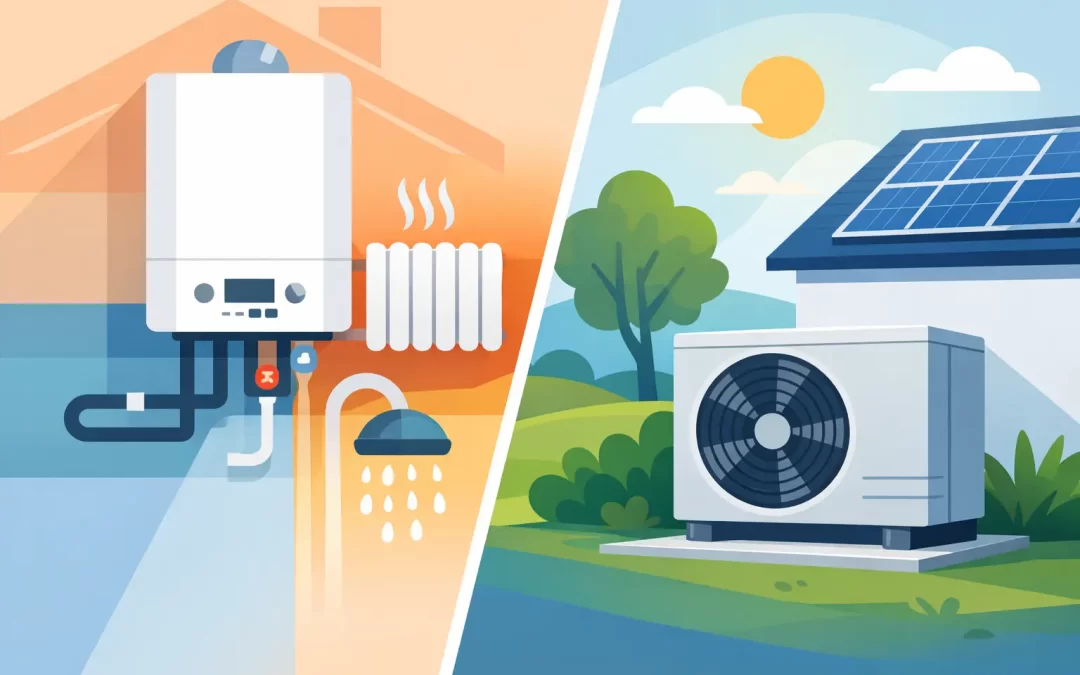
If your boiler is ageing, your energy bills are climbing, or you’re planning a major home upgrade, the combi boiler versus heat pump question quickly becomes a practical one. This is not just about picking new equipment. It affects how your home heats up, how much hot water you get, what the installation involves, and what you are likely to spend now and over the years ahead.
For many households, there is no single right answer. A modern combi boiler can still be an excellent fit for the right property, while a heat pump can offer strong long-term efficiency when the home is suitable. The best choice depends on your property, your existing pipework and radiators, your insulation levels, your hot water habits, and your budget.
Combi boiler versus heat pump – the basic difference
A combi boiler heats water on demand using gas. It provides central heating and instant hot water without the need for a separate hot water cylinder in most homes. That is one reason it remains so popular across London and the South East, especially in properties where space is tight.
A heat pump works differently. In most domestic settings, this means an air source heat pump that takes heat from the outside air and uses electricity to raise it to a temperature suitable for your heating system. Rather than creating heat in the same way a boiler does, it moves heat from one place to another.
That difference matters because it affects how each system performs day to day. Boilers usually deliver very hot water quickly and respond fast. Heat pumps tend to run for longer periods at lower temperatures, which can make them very efficient in the right home, but they need the system around them to be designed properly.
When a combi boiler makes more sense
A combi boiler often suits homes that already have a gas supply, standard radiator systems, and no major plans for insulation upgrades. If your current setup is centred around a gas boiler and you want a straightforward replacement with less disruption, a new combi can be the practical choice.
This is especially true where hot water demand is moderate. In a flat, terrace, or typical family home with one bathroom, a correctly sized combi boiler can deliver reliable heating and hot water with a relatively compact installation. There is no cylinder taking up airing cupboard space, and installation times are often shorter than a full heat pump upgrade.
Cost is another factor. In many cases, replacing an old combi with a new A-rated combi boiler is cheaper upfront than moving to a heat pump system. If the priority is restoring reliable heating and hot water quickly, especially after a breakdown, a boiler replacement is often the simpler route.
That said, combi boilers are not ideal for every property. Homes with multiple bathrooms and high simultaneous hot water demand can find a combi stretched at busy times. If two showers and several taps are in use at once, performance can drop unless the boiler and incoming mains pressure are both up to the job.
When a heat pump makes more sense
A heat pump is usually more attractive where the property is well insulated, has enough outdoor space for the unit, and can operate efficiently with larger radiators or underfloor heating. These systems work best when they provide a steady, lower-temperature heat rather than short bursts of very high heat.
If you are carrying out wider renovation works, upgrading insulation, or planning a long-term move away from gas, a heat pump may be the stronger option. It can be particularly suitable in newer properties or well-upgraded older homes where heat loss has been reduced.
Running costs are where many people focus, but this needs care. Heat pumps are highly efficient, yet electricity is usually more expensive per unit than gas. Whether you save money depends on the efficiency achieved in your home, your tariff, and how well the system has been designed and commissioned. A heat pump installed into a poorly suited property may not deliver the savings people expect.
Installation costs and disruption
This is where the combi boiler versus heat pump comparison becomes very real for homeowners.
A combi boiler replacement is usually the less disruptive option if you already have one in place. Pipework alterations may be limited, and the system can often be swapped with less upheaval. For households that need heating restored quickly or want to keep installation costs under closer control, this matters.
A heat pump installation is usually more involved. The outdoor unit needs a suitable location. Radiators may need upgrading. Pipework may need adjusting. Many homes will also require a hot water cylinder, which takes up space. In some properties, electrical upgrades may also be part of the job.
None of that means a heat pump is the wrong choice. It simply means the installation should be assessed properly rather than treated as a like-for-like swap. A rushed recommendation is rarely a good sign.
Efficiency and running costs
On paper, heat pumps are more efficient than gas boilers. They can deliver more units of heat than the electricity they use, which is why they are often discussed as a lower-carbon option.
But paper performance and real-life performance are not always the same. If a heat pump is installed in a draughty property with undersized radiators and poor controls, efficiency can suffer. If a combi boiler is old, badly maintained, or oversized, that can also waste fuel.
A new condensing combi boiler, fitted correctly and set up properly, can still perform very well. For many homes across Middlesex, London and the surrounding counties, that makes it a sensible and reliable solution, especially where the wider heating system is already based around gas.
The most honest answer on running costs is that it depends on the home. That is why proper surveying matters more than headlines.
Hot water performance
Hot water is often the detail that changes the decision.
Combi boilers provide hot water on demand, which many households like because there is no waiting for a cylinder to reheat. In smaller to medium homes, that convenience is hard to ignore.
Most domestic heat pump systems rely on stored hot water in a cylinder. That can work very well when sized correctly, but it is a different way of using hot water. You need enough stored capacity for the household, and recovery times are different from a gas combi. For larger homes or busy families, a cylinder-based setup can actually be an advantage, but only if the design suits your usage.
If space is limited and you value instant hot water, a combi often has the edge. If your home has room for a cylinder and the system is designed around your demand, a heat pump can still meet your needs comfortably.
What about carbon and future-proofing?
Heat pumps are generally seen as the lower-carbon option, particularly as the electricity grid continues to change. For homeowners who want to reduce reliance on gas and plan for the longer term, that is a strong point in their favour.
A combi boiler does not offer the same carbon benefit, but that does not make it obsolete overnight. Many households still need a heating system that is affordable to install, familiar to use, and well matched to the property as it stands today. If major insulation and heating distribution upgrades are not realistic at the moment, a modern boiler may still be the better fit.
Future-proofing should be practical, not theoretical. The right system is the one that keeps your home reliably warm, supplies hot water properly, and runs efficiently in your actual property.
How to choose between a combi boiler and heat pump
Start with the house, not the trend. Look at insulation, radiator sizes, available space, hot water demand, and whether you already have gas. Think about how long you plan to stay in the property and whether you are willing to carry out wider upgrade works.
Then look at your priorities. If you want lower upfront costs, faster installation, and a straightforward replacement, a combi boiler may be the better route. If you are renovating, improving efficiency across the home, and planning for lower-carbon heating over the long term, a heat pump may be worth serious consideration.
It is also worth remembering that poor installation can spoil either option. Even the best boiler or heat pump will underperform if it is badly sized, badly fitted, or not commissioned properly. Qualified, experienced engineers matter because the design and setup are just as important as the product itself.
At CKT Boilers, this is exactly how we advise customers. We focus on what works for the property, the household, and the budget, rather than pushing a one-size-fits-all answer.
If you are weighing up your next heating upgrade, the best decision is usually the one based on a proper assessment of your home as it is now, with a clear view of where you want it to be in the years ahead.