
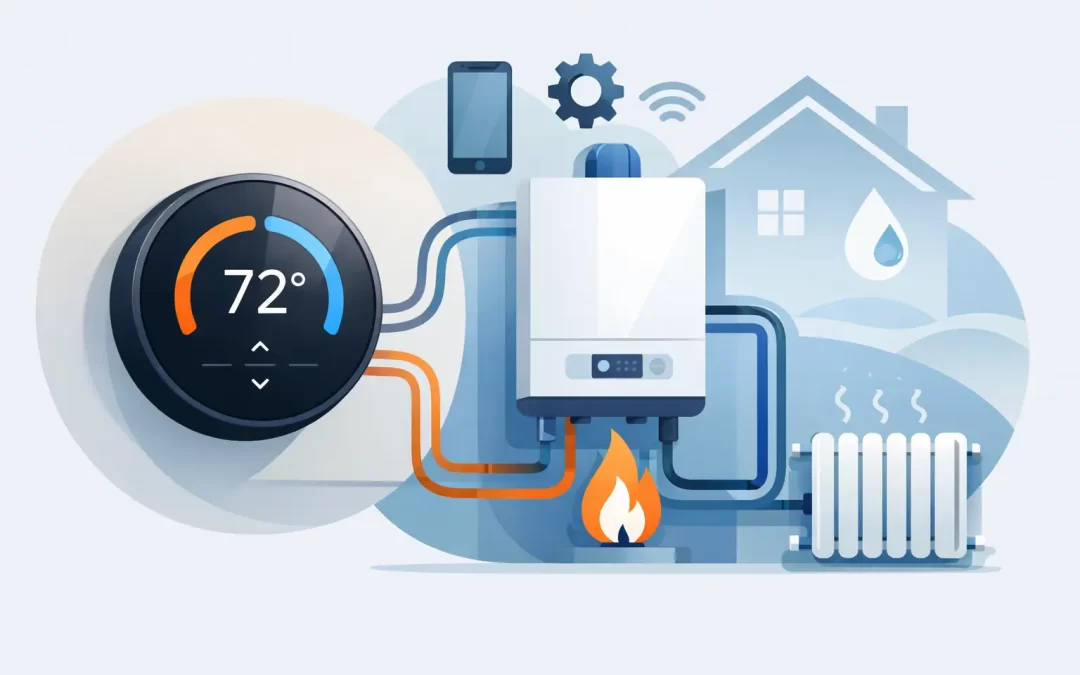
A chilly morning often exposes the limits of an old heating controller. You may wake to a cold house because the timer was set too late, or heat empty rooms because it was set too early. Smart thermostats for boiler systems give you more control over when your central heating runs, but the best option depends on your boiler, controls and household routine.
For many homes, a smart thermostat is a sensible upgrade rather than a complete heating overhaul. It can make schedules easier to manage, allow adjustments from your phone and help the boiler respond more intelligently to changes in room temperature. However, not every smart control is compatible with every boiler, and a poorly planned installation can lead to unreliable heating, hot water issues or lost boiler efficiency.
What a smart thermostat actually does
A conventional room thermostat tells the boiler to switch the heating on when the room falls below a set temperature, then off when that target is reached. A smart thermostat performs the same basic job but adds app control, flexible scheduling and, in many cases, learning or weather-responsive features.
Instead of setting one programme at the controller, you can usually change the temperature from your phone, set different schedules for weekdays and weekends, or turn the heating down when plans change. Some systems use location settings to identify when household members are away. Others learn how quickly your property warms up so they can begin heating at the right time rather than simply at a fixed hour.
The useful feature is not the app on its own. It is the ability to heat the home around real life. If you work from home twice a week, return at different times or manage a rental property, that flexibility can prevent the heating from running unnecessarily while maintaining a comfortable temperature when it matters.
Are smart thermostats for boiler systems compatible?
Compatibility is the first question to answer. Most modern smart thermostats can control many gas boilers through a simple on/off connection. This is often called relay control. The thermostat sends a signal to the boiler requesting heat, much like a traditional wired thermostat or programmer.
Some boilers can also work with more advanced controls that communicate directly with the boiler. OpenTherm is one common protocol, although some manufacturers use their own controls and communication systems. Rather than simply telling the boiler to fire at full output, a compatible modulating control can ask it to reduce or increase its output according to demand. This can support steadier room temperatures and help a condensing boiler operate efficiently for longer.
It depends on the specific boiler model. A smart thermostat may be advertised as compatible because it can switch the heating on and off, but that does not necessarily mean it can use the boiler’s full modulation features. In some cases, the manufacturer’s own compatible smart control is the better choice, particularly where protecting warranty conditions and achieving the intended efficiency are priorities.
Before choosing a thermostat, check the boiler make and model, the existing controller arrangement and whether the property has a combi boiler, system boiler or regular boiler with a cylinder. An experienced heating engineer can confirm the suitable options before any wiring is altered.
Combi boilers
A combi boiler provides central heating and hot water directly from the boiler, without a separate hot water cylinder. In most cases, a smart thermostat controls the central heating only. Your hot water is generally supplied when you open a tap, so it does not need a timed hot water programme.
That makes a smart thermostat installation relatively straightforward in many combi-boiler homes. Even so, the controls must be set up correctly so that the boiler responds reliably and any existing thermostat is not left conflicting with the new system.
System and regular boilers
System and regular boilers are often connected to a hot water cylinder. Here, the controls may need to manage both space heating and stored hot water. A basic smart thermostat may only replace the room thermostat, leaving the existing programmer to control the cylinder.
That can be perfectly practical, but it is worth understanding before you buy. If you want app-based scheduling for both heating and hot water, you may need a smart heating control designed for a cylinder system, with the correct wiring configuration and sensors where required.
Choosing the right features for your home
The best control is one your household will actually use. A complicated system with features nobody understands is unlikely to deliver better comfort or lower usage than a simple, well-programmed thermostat.
Look first at scheduling. A clear seven-day programme is useful for most households, especially where occupancy follows a predictable pattern. Remote access is valuable if you are frequently away, own a second property or want to check that the heating has been turned down after leaving home.
Temperature accuracy also matters. Place the main thermostat in a representative area of the home, away from direct sunlight, draughts, kitchens, fireplaces and radiators. If it sits in the coldest hallway, for example, it may keep the boiler running after the living areas are already warm.
Smart radiator valves can add room-by-room control. They are particularly useful in larger properties, homes with spare bedrooms or households where people prefer different temperatures. Yet they are not always essential. A well-positioned main thermostat, properly balanced radiators and thermostatic radiator valves can be enough for many homes.
If you add smart radiator valves, the system design needs consideration. Do not fit valves that can shut every radiator down without ensuring the boiler has the necessary bypass route or an appropriate radiator left open, where required by the system design. This is one reason professional advice is worthwhile rather than treating heating controls as a purely plug-in purchase.
Installation is more than fitting a new display
Some smart thermostats are battery powered and communicate wirelessly with a receiver near the boiler. Others replace an existing wired thermostat. Both can be neat solutions, but the wiring at the boiler and programmer must be identified correctly.
Older systems may have unfamiliar wiring, separate zone valves, external pumps or controls that have been altered over the years. Replacing one part without checking the wider system can create faults that only become obvious when the weather turns colder. It may also leave a boiler unable to receive the correct heating or hot water demand.
A qualified engineer can assess the existing controls, confirm boiler compatibility and install the receiver in line with manufacturer instructions. Where work involves electrical connections, it should be carried out safely and tested appropriately. For boiler-connected heating controls, this careful approach helps avoid disruption and supports manufacturer-compliant operation.
CKT Boilers can advise homeowners across London and the South East on suitable heating controls as part of wider boiler, central heating and radiator work.
Will a smart thermostat reduce gas bills?
It can help, but it is not a guarantee of a fixed saving. The benefit comes from avoiding unnecessary heating, maintaining more consistent temperatures and using controls in a way that suits the property. A smart thermostat cannot compensate for a failing boiler, poor insulation, undersized radiators or a system full of sludge.
The biggest gains are often behavioural. Turning the heating down when the house is empty, avoiding excessive target temperatures and setting a realistic schedule can all reduce wasted energy. As a guide, a comfortable living-room setting for many households is around 18-21°C, though personal needs vary. Young children, older residents and people with health conditions may require warmer rooms.
Avoid repeatedly switching heating fully off and then demanding a very high temperature later. The right approach depends on insulation, boiler type and how long the home is empty. A sensible schedule and moderate setback temperature can be more comfortable than dramatic daily changes.
When a smart thermostat will not solve the problem
If some radiators stay cold, the boiler loses pressure, rooms heat unevenly or the system makes banging noises, fitting a new control may not be the answer. These symptoms can point to circulation problems, air in the system, poor balancing, a faulty pump, sludge or a boiler fault.
Likewise, if the boiler cycles constantly or fails to reach temperature, it needs diagnosis before investing in new controls. A boiler service, central heating repair, radiator upgrade or powerflush may be more appropriate depending on the condition of the system.
A smart thermostat works best when it is part of a healthy, correctly set-up heating system. Choose a control that suits the boiler rather than the one with the longest feature list, and have it installed with the same care you would expect from any work that affects your home’s warmth and hot water.