
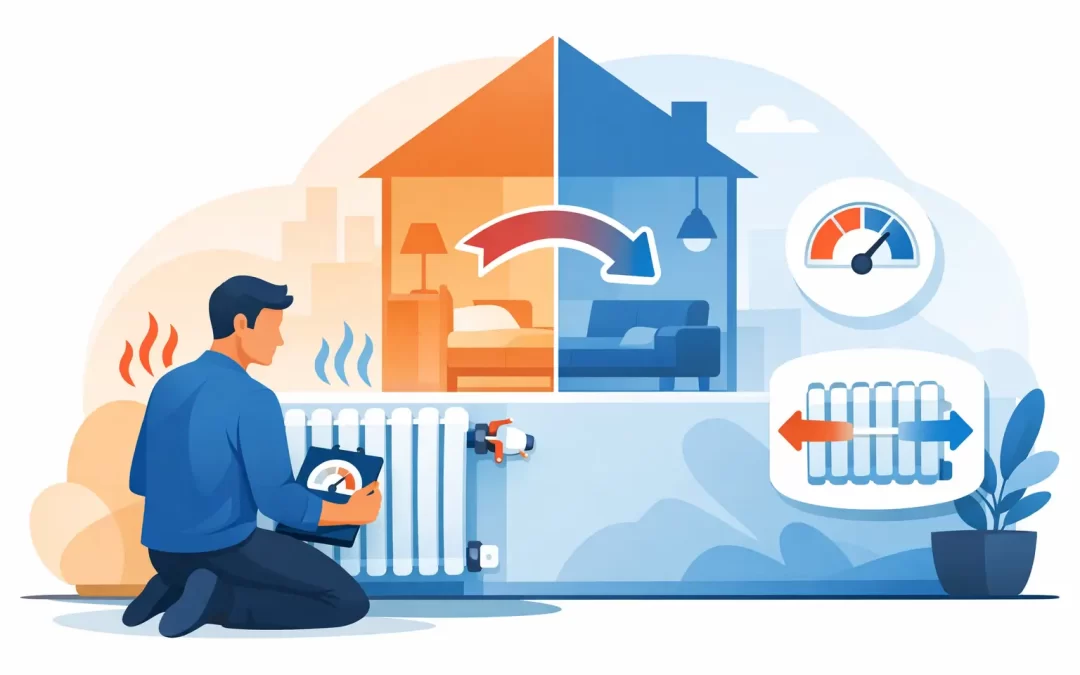
A cold bedroom radiator while the hallway feels tropical is usually not a boiler failure. More often, the heating water is taking the easiest route around the system, leaving radiators further from the boiler short of heat. Learning how to balance home radiators can help every room warm up more evenly, reduce wasted energy and make your central heating feel far more dependable.
Radiator balancing is a practical adjustment, but it needs patience. The aim is not simply to make every valve fully open. It is to control the flow through each radiator so heat is shared properly around your property.
What balancing radiators actually does
When your heating comes on, hot water travels from the boiler through pipework to each radiator and back again. Radiators nearest the boiler or pump often heat up first because the water reaches them with the least resistance. If they take too much flow, radiators at the end of the circuit can remain lukewarm or cold at the top.
Balancing restricts the flow slightly through the radiators that heat up quickest. This encourages more hot water to travel to the slower radiators. It is especially useful in larger homes, properties with extensions, older systems and homes where radiators have been added over time.
Balancing will not cure every heating problem. A radiator that is cold at the top may need bleeding, while one that is cold at the bottom may have sludge inside it. A seized valve, poor boiler pressure, circulation pump fault or incorrectly sized radiator also needs a different solution.
Before you balance your radiators
Start by checking the simple things. Make sure your boiler pressure is within the range recommended by its manufacturer when the system is cold. Set all thermostatic radiator valves, often called TRVs, to their highest setting while you are balancing. If one is set low because a room is already warm, it can close and give misleading results.
You will also need to identify the two valves at the bottom of each radiator. One is normally the control valve or TRV. The other is the lockshield valve, usually hidden under a plain plastic cap. The lockshield is the valve used for balancing.
Let the heating cool fully before making adjustments. Lockshield valves can be stiff on older systems, so do not force them. Take a photograph of each valve position or count the turns as you move it. That gives you a route back to the original setting if needed.
For the most accurate approach, use two clip-on or digital pipe thermometers. They allow you to compare the temperature of the pipe feeding each radiator with the pipe leaving it. A professional engineer will use commissioning information for the particular system, rather than relying only on how hot the radiator feels.
How to balance home radiators step by step
Open the system and heat it from cold
Turn the heating off and allow the radiators to cool. Open every lockshield valve fully by turning it anti-clockwise, then set each TRV or manual control valve fully open.
Turn the heating back on and keep an eye on which radiators warm up first. The fastest one is often closest to the boiler, although pipework layouts can produce surprises. Give the system time to warm through properly – rushing this part often leads to inaccurate adjustments.
Restrict the fastest radiator first
Once the first radiator is hot, turn the heating off again if you need to handle a valve near hot pipework. Remove the lockshield cap and gently close the valve clockwise until it stops. Then reopen it by around a quarter of a turn as a starting point.
Turn the heating back on and allow that radiator to warm up. Restricting its lockshield slows the water flow through it, giving other radiators a better share. The radiator does not need to feel as hot as possible. It needs to release enough heat for the room while allowing the whole system to work evenly.
Work through the remaining radiators
Move through the property in the order the radiators heat up. The next-fastest radiator will usually need its lockshield opened slightly more than the first. Radiators that take longer to warm may need half a turn, a full turn or more. The slowest radiator, often furthest from the boiler, may need to remain fully open.
Make small adjustments only, usually a quarter turn at a time. Then wait several minutes before deciding whether the change has helped. Central heating water does not respond instantly, and repeated large adjustments can make it harder to judge what is happening.
Check the flow and return temperatures
If you have pipe thermometers, place one on the flow pipe entering the radiator and one on the return pipe leaving it. The return should be cooler than the flow, showing that the radiator is transferring heat into the room.
There is no single temperature difference that suits every home. A traditional boiler system, low-temperature boiler setup and heat pump system may all be designed to run differently. As a rough domestic starting point, some systems are balanced around a 10-12°C difference across a radiator, but the correct target depends on the boiler, controls, radiator design and original commissioning requirements.
If your boiler manufacturer or installer has specified a target temperature difference, follow that instead. Chasing a generic figure can reduce comfort or affect boiler efficiency.
Let the system settle, then make a final check
When every radiator has been adjusted, leave the heating running for at least 30 minutes. Walk through the home and check whether rooms are reaching a comfortable, consistent temperature. Refit the lockshield caps once you are satisfied, as they protect the valve from knocks and accidental adjustment.
Finally, return each TRV to the setting you normally use. Bedrooms are often kept cooler than living spaces, but avoid turning radiators off entirely in cold weather if that could create damp or condensation problems.
Common signs balancing is not the answer
A correctly balanced system should heat rooms more evenly, but it cannot overcome a mechanical fault or dirty system. If you notice any of the following, it is sensible to arrange a professional heating inspection rather than continuing to adjust valves:
- A radiator is cold at the top and needs frequent bleeding.
- The bottom of one or more radiators stays cold, which can indicate sludge.
- Boiler pressure drops repeatedly or you can see a leak.
- The boiler is noisy, locks out or shows an error code.
- Several radiators stay cold even with valves fully open.
- A valve is seized, leaking or difficult to turn.
Sludge and debris can restrict pipework and radiator channels, particularly in older heating systems. In those cases, powerflushing or a targeted system clean may be more effective than balancing alone. A heating engineer can also check the pump, system filter, boiler settings and radiator output to find the actual cause.
Should landlords and homeowners balance radiators themselves?
Basic balancing is manageable for many confident homeowners, provided the valves are accessible and in good condition. It is a low-risk adjustment when carried out carefully, with the heating allowed to cool before touching hot components.
However, properties with multiple heating zones, underfloor heating, heat pumps, unvented cylinders or complicated controls are best left to a qualified engineer. The same applies if you have recently had a new boiler installed or replaced radiators. Proper commissioning is part of getting the efficiency and comfort you paid for.
For landlords, even heating is more than a comfort issue. Persistent cold rooms can lead to tenant complaints, condensation and avoidable call-outs. A professional service visit can establish whether a simple balance is enough or whether the system needs cleaning, repairs or control upgrades.
Keep your heating balanced for longer
Once your radiators are working evenly, a few simple habits can help preserve the result. Bleed radiators when air is present, keep boiler servicing up to date and avoid changing lockshield valves unless there is a clear reason. If you replace one radiator, redecorate around valves or make changes to the pipework, the system may need balancing again.
If your home is still unevenly heated after careful adjustments, do not put up with cold rooms or keep turning the thermostat higher. A qualified heating engineer can identify whether the issue is circulation, sludge, controls or radiator sizing, and help restore the reliable warmth your home should have.