
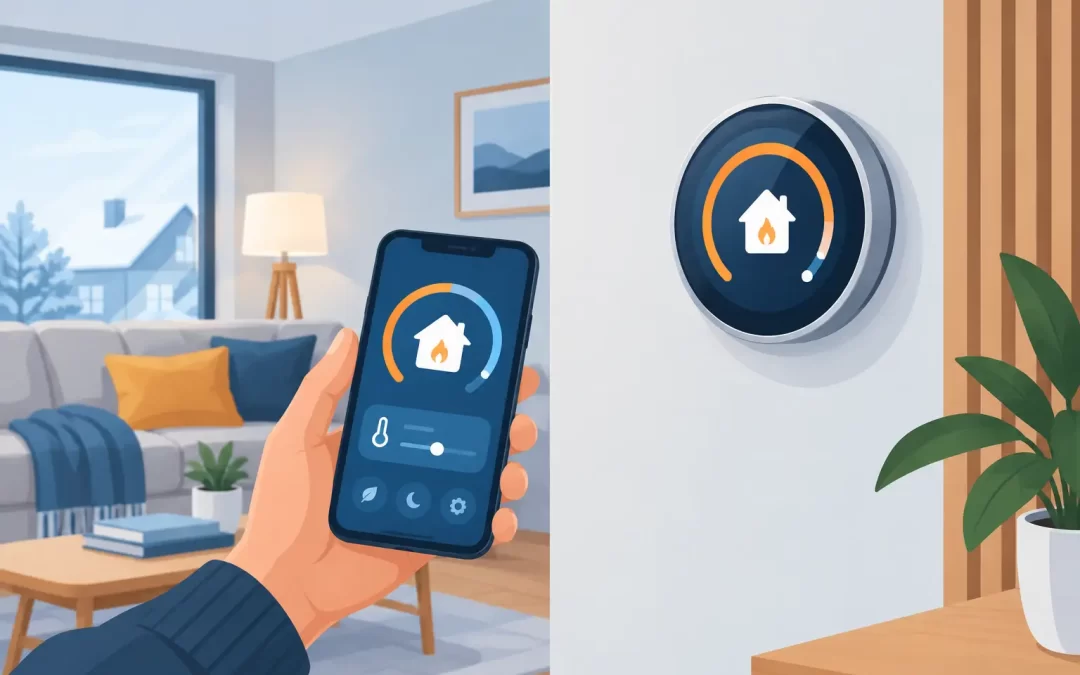
A cold upstairs bedroom, a stuffy lounge and a heating bill that feels higher than it should be are often signs that your controls are not keeping up with how your home is actually used. This smart heating controls review looks beyond the app and the advertised energy savings, helping UK homeowners decide whether a smarter thermostat is a worthwhile upgrade.
Smart controls can make central heating more convenient and, in the right property, more efficient. They are not a cure for a poorly performing boiler, blocked radiators or inadequate insulation, however. The best results come when the controls suit the heating system, the household routine and the condition of the home.
What smart heating controls actually do
A traditional room thermostat tells the boiler when the temperature has fallen below a set point. A timer adds a schedule, but it is usually fixed and fairly basic. Smart heating controls build on this by allowing you to adjust heating from a mobile phone, create more detailed schedules and, in some cases, control individual rooms.
Most systems include a central smart thermostat and a receiver connected to the boiler. Many can learn how quickly your home warms up, use local weather information or detect when nobody is at home. Some are designed to work with smart radiator valves, allowing different temperatures in separate rooms.
That sounds straightforward, but feature lists can be misleading. The most useful control is not necessarily the one with the most options. It is the one that your household will use properly without constantly overriding it.
Smart heating controls review: the benefits and limits
The main benefit is control around real life. If plans change and the house is empty for the evening, you can turn the heating down without returning home. If you are working from home in one room, you may be able to heat that space while keeping bedrooms cooler. For families with different routines, this can be far more practical than a single morning and evening programme.
Comfort is often the first improvement people notice. Better scheduling can mean the home reaches a comfortable temperature when you need it, rather than running too early or being switched on after everybody is already cold. Remote access is also useful for landlords, second homes and households returning from a trip away.
Savings are possible, but they depend on behaviour and system setup. A smart thermostat cannot reduce the cost of heating a draughty property to an unrealistic level. It can help prevent waste from heating an empty home, overheating rooms or running the boiler longer than necessary. If your existing timer is already carefully programmed and you rarely change it, the financial difference may be modest.
There is also a trade-off between convenience and complexity. App-based controls depend on a reliable broadband connection for full remote features, and every household needs someone comfortable managing settings. A system with room-by-room controls can be excellent in a larger home, but it brings more components, more batteries and more decisions.
Features worth paying attention to
Look first at scheduling. A good system should let you set different temperatures at different times, rather than simply switching on and off. This gives the boiler a clearer target and avoids unnecessary overheating.
Geofencing, which uses a mobile phone’s location to suggest heating changes when occupants leave or return, is useful for some households. It works less well when family members have irregular movements, leave their mobile phones at home or prefer predictable schedules. Treat it as an optional convenience, not a reason to choose a product on its own.
Room-by-room control is valuable where rooms are used very differently. Smart radiator valves can keep a spare room cooler while maintaining comfort in a nursery, home office or living room. They are less compelling in a small flat where internal doors are usually open and one central thermostat already represents the whole space reasonably well.
Hot water control matters if you have a conventional or system boiler with a hot water cylinder. Check that the chosen control can schedule heating and stored hot water separately. Combi boiler households do not store domestic hot water, so this feature will not normally be relevant.
Compatibility matters more than the brand name
Before buying a smart controller, establish what boiler and heating system you have. A control that suits a modern combi boiler may not be the right choice for an older boiler with a cylinder, underfloor heating, multiple heating zones or unusual wiring.
Many smart thermostats can provide simple on-and-off control. This is widely compatible, but it does not always allow the boiler to run at its most efficient. Some modern boilers and controls can communicate using protocols such as OpenTherm or a manufacturer-specific system. This allows the boiler to modulate its output more intelligently rather than repeatedly firing at full power.
Where compatible, modulation can improve comfort and efficiency, particularly with a condensing boiler operating at lower flow temperatures. But compatibility must be checked rather than assumed. Fitting a third-party device may remove certain advanced functions available through the boiler manufacturer’s own controls, even if the heating still operates normally.
It is also worth considering warranty requirements. Boiler manufacturers may recommend particular controls or installation methods to maintain optimum performance and ensure the installation remains manufacturer-compliant. A qualified heating engineer can assess the existing wiring, thermostat position, boiler model and controls before recommending a route forward.
Do smart radiator valves work with every radiator?
Not always. Smart radiator valves usually replace the thermostatic radiator valve head, not the valve body itself. They need compatible valves and enough clearance around the radiator. Older manual valves may need upgrading first.
A bypass route or an appropriately controlled radiator is also important for many systems. Closing every radiator valve at once can cause circulation problems. This is one reason room-by-room heating should be designed as part of the wider system rather than added piecemeal.
If radiators are cold at the bottom, slow to heat up or noisy, deal with those faults before expecting controls to transform performance. Balancing, radiator repairs or powerflushing may be needed, depending on the cause.
Which homes gain the most?
Smart controls tend to be most worthwhile in homes with changing schedules, rooms that are used differently or heating that is currently managed by a basic timer. They can also make a noticeable difference for people who regularly forget to turn the heating down when leaving home.
Larger properties with several bedrooms, loft conversions or home-working spaces can benefit from zoning, provided the system is specified properly. In a well-insulated newer home, the gain may be more about fine temperature control than dramatic bill reductions. In an older, less insulated property, controls help, but draught-proofing and insulation should sit alongside them.
For landlords, simple and durable controls are often a better choice than a complex setup that tenants may not want to manage. Clear instructions, a sensible default schedule and reliable manual operation are valuable if Wi-Fi drops out or a mobile phone is changed.
Installation is not just a wiring job
Some battery-powered smart thermostats are marketed as easy to fit yourself. Even where that is technically possible, central heating controls connect to equipment that affects household comfort, energy use and, in many homes, the boiler’s safe operation. Poor wiring, unsuitable settings or an incorrectly positioned thermostat can lead to unreliable heating.
The thermostat should not sit near a radiator, cooker, open fire, direct sunlight or a draught. It needs to reflect the temperature of the area it is controlling. The installer should also check that the boiler responds correctly, the hot water programme works where relevant and any existing programmer or thermostat is not left conflicting with the new controls.
For more involved systems, professional installation is particularly sensible. This includes properties with hot water cylinders, multiple zones, underfloor heating, smart radiator valves throughout the house or a new boiler installation. CKT Boilers can assess compatible control options as part of a heating upgrade, ensuring the boiler, radiators and controls are working towards the same goal.
A practical way to choose
Start with the problem you want to solve. If the issue is forgetting to turn the heating down, a reliable app and easy scheduling may be enough. If certain rooms are always too warm or too cold, investigate zoning and radiator valves. If you are replacing an ageing boiler, ask about controls at the same time so compatibility and efficient operation are considered from the outset.
Avoid choosing purely on the promise of savings. Check the ongoing costs, whether subscriptions are required, how the control works during an internet outage and whether everyone in the household can use the manual controls. A simple system that is well installed and used consistently will usually outperform an advanced one that is left on default settings.
The right smart control should make your heating less noticeable: warm rooms when you need them, less energy wasted when you do not, and a system that remains straightforward to manage when life gets busy.